|
Click here to
submit your sea anchor or drogue article for
FREE!
Popular
Sea Anchor Articles
How
to Deploy & Retrieve The Sea Anchor or
Para-Anchor
Sea Anchor VS
Para-Anchor
Jordan Series Drogue
VS Sea Anchor, Para Anchor or Drogues
Sea Anchor and Para
Anchor Debate - One More Round on the Issue
"Sea Anchor Basics"
And
Why You Should Carry One
by Matt Henry
apppearing in Sport Fishing Magazine
The idea of using a submerged cloth “bag” to slow the
drifting speed of a boat and to keep
its bow into the
wind has been around for centuries. The first such sea
anchors were generally cone-shaped and made from heavy
canvas. Then, around the end of World War II, it was
discovered that parachutes, with their “dome” shape
created more water resistance with a given amount of
material than did cone shaped sea anchors...Read
Article

“Sea Anchor Match-up”
appearing in Practical Sailor Magazine
Sea
anchors have evolved to become a vital component of the serious sailor's
arsenal in heavy weather.
We tested
models from Para-Tech and Fiorentino,
and favor Fiorentino's for their rugged
construction...Read
Article
"The parachute Anchor"
By Cary V. Deringer
appearing in Sail Magazine.
When weather conditions start to deteriorate, a sea anchor can be a handy piece of gear”
When it comes to dealing with heavy weather at sea,
sailors have a number of options. One is to reef down
and then heave-to. Another is to stream a drogue astern.
A third is to deploy a parachute sea anchor. My husband,
Bob, and I have a sea anchor aboard our 36-foot cutter,
Illusion, and we’re glad we do...Read
Article
"Without A Rudder"
by Herb McCormick"
excerpt appearing
in Cruising
World
"The torn, trashed
drogue didn't fare
as
well, though it would've
been a
struggle to reach Nassau
without it."
It'd been a bouncy, wet, exhilarating 13
hours since we'd answered the starting gun off
Fort Lauderdale last February 4 to begin the
roughly 800-mile race to Jamaica in the 2005
edition
of the biennial Pineapple Cup...Read Article
"The onset of new
technology dispels
old rumors from decades passed" by Michael David”
appearing
July 2002 Para-Anchors—Myths vs. Facts.
Many of the myths surrounding modern para-anchors derive
from the mishaps of old-time sea anchor designs. Canvas,
PVC, and lightweight
(2- to 4-ounce) surplus anchors,
for example, have a reputation of
inflating on deck,
rotating until tangling occurs or breaking apart.
However, when properly designed and rigged, today’s
parachute
anchors have a very low fail rate...Read
Article
“Drag devices: Parachute anchors
& drogues" by Cary Deringer
appearing in Good Old Boat Magazine
Taking the weather for granted is easy to
do on a nice day. Sails are filled with a gently wind, and the boat
heels slightly as is slices through rippling water shimmering beneath a
warm sun. On days like these it is hard to imagine that sailing can be a
totally different experience when conditions turn rough...
Read
Article
“No silver bullets"
by Lin &
Larry Pardey
apppearing in
the May/June 2002 issue of Good Old Boat.
Your January 2002
issue reached us in Argentina as we were
cruising south along the Patagonian coast. So
heavy weather is much on our minds. We therefore
read Cary Deringer’s discussion of sea anchor
and drogues immediately…
Read Article

“Agreed: no silver bullets"
by Carry Deringer
appearing
in the May/June
2002 issue of Good Old Boat.
We agree with Lin and Larry 100 percent.
I noted in the article that
silver bullets are
hard to come by for a number of reasons. Parachute
sea anchors and drogues are just two more tools in the toolbox when it
comes to making a decision in heavy weather...
Read Article
“One more round on the drag device
issue" by Zack Smith
appearing
in the July/August 2002 issue of
Good Old Boat.
Recently I completed a series of open-sea tests of drag devices that I
designed for U.S. military use. These tests took place under different
sea and weather conditions,
including storms. When I was done I headed
back into port and took some time to catch
up on my reading...Read
Article
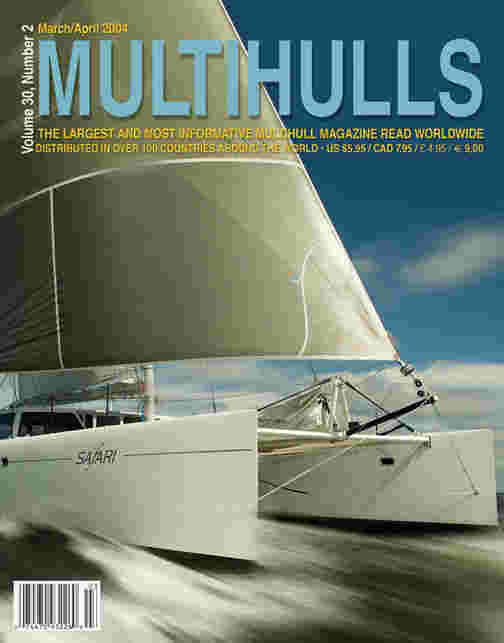
“The parachute—in heavy weather sailing”
By Casanova
appearing in
Multihulls.
The theory on parachute sea anchoring
during severe gales mentioned in books and magazines draws a horrible
picture of the boat being pulled through the giant waves. I have
proved this theory wrong but if it were so, it would be better to go
through the top four or five feet of wave than upside down...Read
Article
“Maitenes II in the
Fastnet race—an
account of her ill-fated passage last
summer" by Luard
appearing in Yachting.
Though there was a record entry list for last year’s Fastnet Race, and
though the leading ships completed the course in record time,
the loss
of Colonel Hudson, part owner of Maitenes II, was a tragedy about which
it
is difficult to write. “But the Fastnet Race had, like other
sports,”...Read
Article

“The cruise of Sea Bird”
By F. B. Thurber
appearing in Yachting.
In 1911, when “Sea Bird” and her three-
men
crew started on their voyage to Rome via the Azores, long ocean passages
in relatively small boats were an almost
unheard of yachting practice...Read
Article
“You
know
how
to use your life preserver.
But what about your boat’s?
"Knowing how to use
your para-anchor can save your life" by Zack Smith ”
appearing in the 2001 issue of Santana.
Your
parachute sea anchor can do more
than steady your boat in heavy
seas. It also saves lives! But, there’s a catch. It can’t do you or
your boat any good unless you know how to use it properly. That
means you
have to practice. Practice Gives You A
Clear
Advantage. It’s estimated that 90 percent of para-anchor
owners don’t practice
using their underwater
drag device. And that’s incredibly dangerous!
Read Article
“Heaving-to: safety valve
at sea"
by Larry Pardey”
appearing in Sail Magazine.
Heaving-to is a sailing tactic that buys
you time: time to stop and rest; time to wait for the fog to clear; time
for daylight to arrive so you can enter a new port safely; time to
double-check your navigation; time to make repairs. You can heave-to and
wait near another ship while you transfer people or supplies...Read
Article
|




 All You need to know about Sea Anchors, Parachute
Anchors & Drogues
All You need to know about Sea Anchors, Parachute
Anchors & Drogues